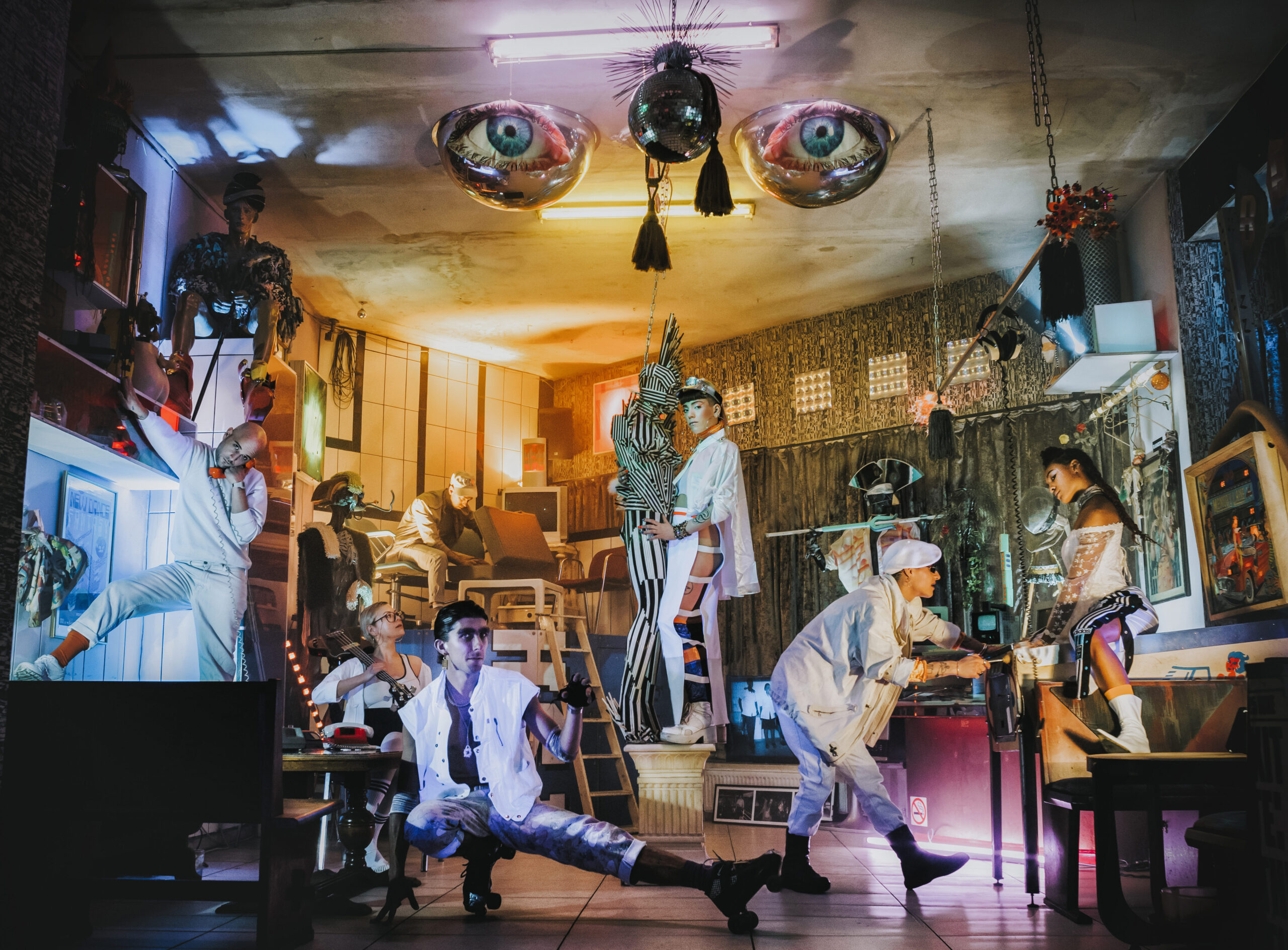
If you’re reading this, Nathan Dukes would like his Dalmatian back. His leopard, too. Distinguishing marks (applicable to both): spotted, give-or-take a metre tall, glazed-ceramic build. The pair of pilfered statues were last seen crouching in the corner at Sameheads on Richardstraße, and they’re not the only artefacts to have been rendered unwilling mementoes over the years; a couple of TV monitors have also walked out the door, along with chairs, a tribal headpiece from Thailand and a couple hundred whimsical ashtrays.
Chalk it up to his British upbringing that Dukes has maintained a stiff upper lip in the face of such wanton larceny. The longtime Sameheads owner adopts a pint-glass-half-full perspective: “If no one ever tried to steal anything, we’d probably be doing something wrong.” That’s one way to measure success. Another way is to simply add up the years until they reach a nice round number, then shout “Prost!”, if the place hasn’t yet been shut down by the cops.
Which brings us, finally, to the point at hand, though let it be said that the path Dukes took to celebrating 20 years at his Neukölln ‘pub-club’ was no less circuitous. It begins with three brothers, ends with one and along the way accounts for an impressive range of the subcultural flavours that make Berlin such a moveable feast. The story of the club reflects the increasingly fraught story of the city’s weirdo-outsider-nightlife scene. Several of its key moments play out in abandoned party spaces that no longer exist. But what seems to keep Sameheads going is the distinctively Berlinerisch idea that if you keep moving, keep adapting and keep listening, the strange notes of the universe will someday start to sound like your own theme song.
In the Land of Well-Dressed Misfits

When the Dukes brothers – oldest brother Nathan, middle brother Leo and youngest brother Harry – first landed in Berlin in early 2005, their eyes were brightened and their bushy tails wrung dry by the hedonic excesses of the city’s party scene. When they finally came up for air, they couldn’t remember much of what had happened. But they all agreed that This Must Be the Place. So they returned for good in 2006, armed with precious little money, precious little German and (bless their souls) their CVs saved on a floppy disk.
Miraculously, the Dukes’ fraternal philosophy of ‘radical unpreparedness’ paid off almost immediately when they stumbled into a small space tucked behind the costume rental shop Bonnie & Kleid in Bergmannkiez. It only took them a few months to stand up the very first iteration of Sameheads – a clothing and record store specialising in silkscreen t-shirt production, vintage vinyl and what the locals might call Krimskrams or Kuriositäten (apropos of nothing, e.g. a one-metre-tall ceramic dog).
We approached everything with a DIY punk mentality. If we couldn’t find the perfect venue, we’d create one.
“It didn’t take long before the local misfits, creatives and curious characters found us,” remembers the elder Dukes, who confirms that this was more or less the plan all along. “Berlin was a very different city back then. There were far fewer internationals, minimal techno was king and the fashion scene was understated to the point of uniformity.” Though opening a business wasn’t on any of the brothers’ newly minted expat bingo cards, they all felt there was untapped space for “something a little stranger”. More often than not in the early days, ‘stranger’ translated to experimental fashion design, and the Dukes jumped at the chance to collaborate with then-fresh-faced labels like tHERAPY Recycle & Exorcise, FADE OUT Label and Tata Christiane.
Anyone who happened to spend any time in this primordial Sameheads might have remarked on its chaotic and (indeed) strange amalgamation of fashion, music and art. But this mixed-media mixture has continued to define Sameheads, long since it shed the original store concept for a more party-centric approach and moved to its current home on Richardstraße. Whoever said the centre can’t hold?
“Organised Chaos”: The Party Collective Years

It would be inaccurate, or at least incomplete, to describe the history of Sameheads as the mere evolution of a physical space. It was more than a move from Kreuzberg to Neukölln, a shift from record shop to sweaty nightclub. For six years or so following the Dukes brothers’ move to Berlin, the artists and revellers in their orbit didn’t think of Sameheads as a shop or a club at all. It was more like a synonym for a good time.
“We actually built our reputation as a party collective,” says Nathan, who had masterminded blowouts in the UK for years prior. By his telling, it was simply a matter of when and how the “organised chaos” would eventually spill over into something more shapeless and venue-agnostic. “We approached everything with a DIY punk mentality. If we couldn’t find the perfect venue, we’d create one.”
The first big Sameheads event took place in a former Kindergarten near Frankfurter Tor. It serves as a case in point of this ramshackle ethos, and (more generally) of the charmingly bizarre opportunities once offered by East Berlin. The Kindergarten met the brothers’ lax criteria of ‘abandoned’ and ‘unlocked’, and so they rented a sound system, hauled in three van loads of mattresses to soundproof two floors and crossed their fingers. “We somehow managed to dodge the police for two days straight,” says Nathan, wisely omitting the details. “When it was all over, we knew we were onto something.”
Track down a scene veteran and they’ll fill you in on the rest: quarterly raves at the Computer Chaos Club, weekend blowouts at Fort Gorgast on the Polish border, a hallowed run of nights at Raum 18, Raum 20 and later Raum, perched 10 stories up in an industrial complex on Ziegrastraße. Yes, the brothers Dukes were onto something – and it wasn’t just a good time.
As the years sped past in a disco-ball blur, their large-scale, multi-floor disco marathons became a blueprint for Berliners with similar ambitions. “Our parties carved out a lane of their own,” says Nathan. “[We were] mixing music, art and performance in ways that weren’t really happening elsewhere in the city.” Once the proof of concept was in place, it didn’t take long to catch on. The halcyon days of the late aughts ushered in a procession of new party collectives, and the Sameheads DNA was suddenly everywhere.
Finding Richardstraße


As blissfully chaotic as Sameheads’ quarterly events were, Nathan and his brothers eventually found themselves asking the same question the morning after: ‘What if we built a place of our own?’ It wasn’t just a physical space they were after (it’s hard to beat an abandoned Kindergarten for ambiance, after all). They wanted, as Nathan puts it, “a place with its own sound, its own atmosphere and its own identity”.
What they found was an old copy shop on a residential street in Neukölln. Pretty much every word of that description might have struck a saner hipster’s ear as a disqualifier 15 years ago, when Neukölln didn’t yet possess its current cachet among Berlin’s party-going set. But the Dukes had thrown a couple of successful after-hours parties at the then-newly-opened Loophole (RIP) nearby, and they had an inkling of where the neighbourhood’s winds might be blowing.
“When we first arrived, Richardstraße was lined with empty shops, boarded-up windows and the occasional sign of life,” Nathan remembers. “It felt forgotten in the best possible way. People made the journey to Sameheads because there wasn’t much else happening around here.” When they arrived, it was hard to miss the haphazardly decorated clothing-shop-slash-nightclub among the street’s otherwise subdued storefronts.
The Dukes arrived at the perfect moment – the only moment, really, when the idea of converting a run-down copy shop into a polymorphic arts venue wouldn’t get you laughed out of a local council meeting. Luck played its typical role. But nothing this lovingly weird gets built without a commensurate dose of patience and back-breaking work.
The Sameheads Sound


The work hasn’t even finished yet; maybe it never will. The wallpaper (printed, fittingly, at the neighbourhood copy shop) is liable to change from month to month, dognapped sculptures make way for cyborg humanoids and a general sense of misfit transience pervades the place, which is funny, given Sameheads’ growing status as a legacy institution.
To hear Nathan tell it, though, all this change belies the low-key sense of comfort Sameheads settled into over the years. “We like to think of it as a pub-club,” he says. “Come for a drink, stay for the music, meet some strange and wonderful people and hopefully leave with a story worth telling.”
It didn’t take long before the local misfits, creatives and curious characters found us.
More often than not, those stories revolve around Sameheads’ musical programming, which has a knack for showcasing the best shit before everybody else does. International house names like Call Super, Objekt and Hunee have all manned the decks in the club’s charmingly dingy basement, and the biggest clubs in Berlin routinely play host to former Sameheads residents and regular DJs. It’s one more ironic thing about Sameheads to count among a growing list: the little-club-that-could now functions as a sort of farm team for the scene it never showed much interest in joining.
The in-house Sameheads music label follows the same trailblazing logic. “The label has never been about making money,” says Nathan. “If anything, it’s the opposite.” The grand strategy is to “put out music when it feels right”, which translates to a sporadic release schedule that nonetheless reflects the best and most vital sounds of Sameheads’ musical cosmos.
Nathan asserts editorial control over the vinyl compilation series, which has released work by Kris Baha, Rodion G.A., Alessandro Adriani, Alexander Arpeggio, Epsilove, An-i, Schulverweis, Das Kinn and Anklepants across the years. The other side of the label is a cassette mixtape series, curated by the likes of Andy Votel, Albion, Vladimir Ivkovic, Izabel and other artists he trusts to capture the essence of Sameheads on tape.
Sameheads, Different Day

It’s probably no accident that both sides of the label are given over to analogue formats, as Sameheads itself is beginning to feel a step outside the flow of time, and especially so amidst the seismically shifting culture of 2020s Berlin.
“What was once a club hub is increasingly becoming a tech hub,” says Nathan, without the note of bitterness you might expect. He sees the Sameheads of today as “a strange relic that no longer fits into the polished version of Neukölln that has emerged around it”. But this has never been a place particularly concerned with fitting in, and there’s a sense that the Sameheads recipe tastes all the richer with a dash of temporal displacement.
If you can believe the best days are still ahead after reading such an elegiac coda, well, you might be Nathan Dukes himself. Though brothers Leo and Harry dropped out in 2013 and 2020, respectively, the eldest remains committed to steering the Sameheads ship into its next phase. Following a 20-year celebration event in Berlin (details forthcoming), he’ll be taking Sameheads on the road in October, with satellite events planned at Zentralwäscherei in Zurich and Salon des Amateurs in Düsseldorf. And somewhere in the near-to-middle-distance are new label releases from High Light and Leona Jacewska.
“Twenty years in, we’re still finding new reasons to keep things interesting,” says Nathan. If only we were all so dogged, which reminds us: Sameheads would still like their Dalmatian back.