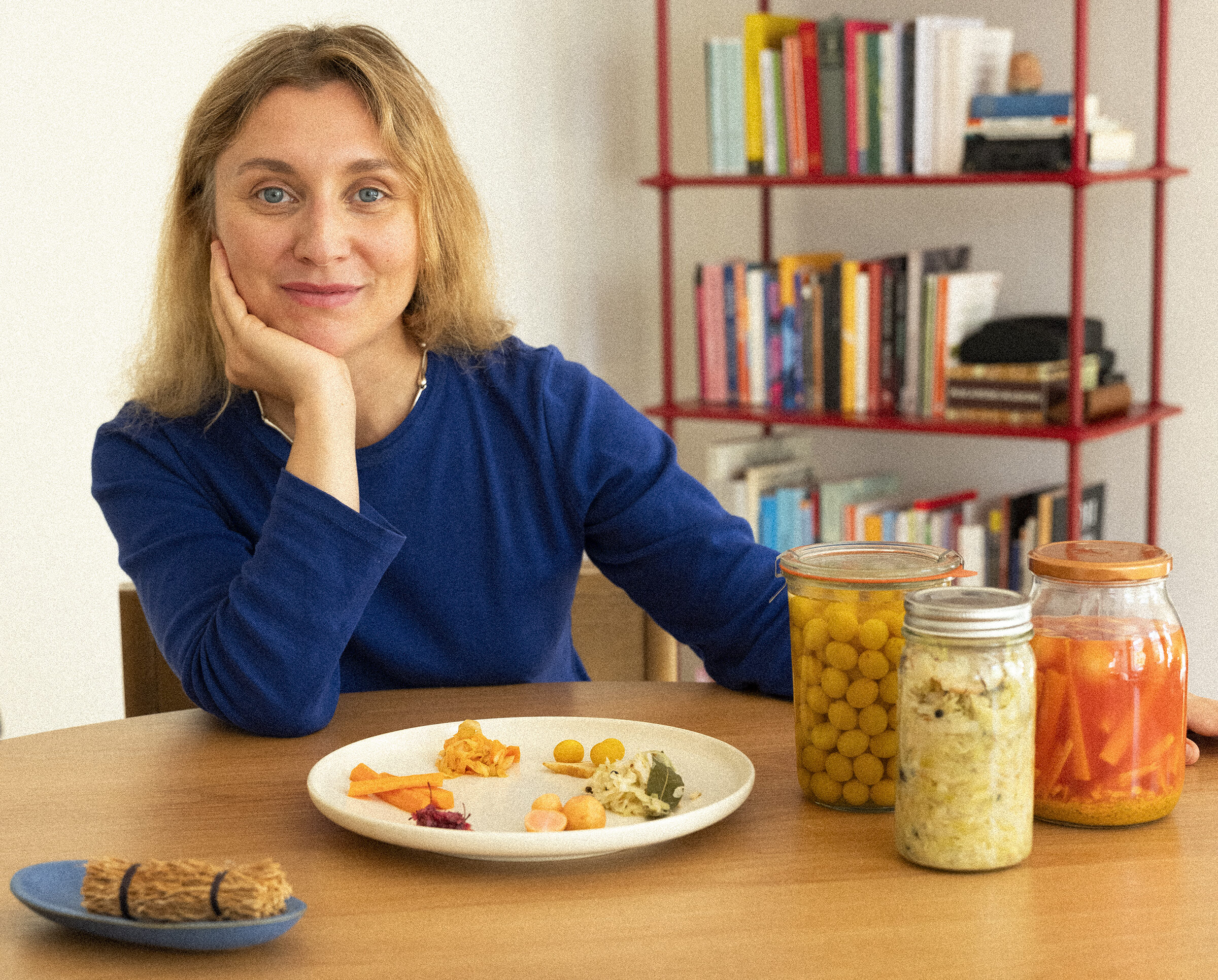
Fermentation isn’t simply about what happens to cabbage in a jar. It’s about what happens when you stop trying to impose an outcome and start paying attention to the conditions around you. More literally, it’s the act of allowing microorganisms like bacteria, yeast or moulds to do what they want to do. Without needing oxygen, they’ll break down sugars and starches and turn them into something else, like acids or alcohol. Fermentation is what helps your bread rise. It brews your beer and wine. It creates that tangy taste in foods like yoghurt and kimchi. But fermentation, the age-old act of preservation, is also an act of letting go.
No one knows this better than Olya Tarasyeyeva, a Ukrainian-born food designer, sociologist and educator. For her, fermentation is the slowest way of cooking, less about the outcome than the journey: “Cooking is rather a performative act. Fermentation is informative.” Olya studied media design and spent more than seven years working as a graphic designer for major global brands. Eventually, the work began to feel emotionally unrewarding. “I’m not nourishing or comforting anyone,” she remembers thinking. She had always been drawn to crafts, history and philosophy, and hosted dinners and cooked experimentally under the philosophy: “I never wanted to replicate a classic.”

London gave that instinct a practical direction. At a small, sustainable restaurant sourcing from local farms, she encountered fermentation as a way of working only with what was available. Later, at Berlin’s Kin Dee, where the cooking was contemporary Thai but much of the produce was local, fermentation became a way to build flavours that might otherwise depend on ingredients that didn’t grow in northern Germany. The point wasn’t to make a perfect imitation of a dish elsewhere. It was to understand the principle well enough to make something that belonged in Berlin.
Then came the accident.
A few years ago, doctors told Olya she might never work with her hands again. For someone whose career depended on making things, the loss was huge. “I not only lost my work, but also my identity, because my hands were like the speakers with which I spoke to the world,” she says. During rehabilitation, she began foraging again and returned to memories of her grandparents’ summer house in Ukraine and its lush garden. She reconnected with a way of working she had encountered in childhood: preserving what was there, giving it time and allowing transformation to happen. “Fermentation was just a natural extension of foraging and something that gave me a sense of agency.” She began selling online fermentation workshops and built a brand called Fizzy Treasures.


Her regular workshops at Studio32, the culinary studio connected to Berlin’s Michelin-starred Bonvivant, teach that fermentation is as much an act of mindfulness as it is a timeless tradition of preserving food. Olya begins each workshop with a warning: “We are not entirely in charge.” A group of us gathers around a communal bowl. We’re making a version of Sauerkraut, an autumn pumpkin kimchi and a shrub from apple cider vinegar and dates. There is cabbage. There is salt. There are jars. There are instructions. Then there are the microorganisms, which haven’t agreed to follow any of our rules. Fermentation is often presented as either a wellness project or an elaborate culinary technique. For Olya, it’s a way of making that depends on knowledge and intention without promising complete control. “Food is both my medium and the message,” she tells me.
Food is both my medium and the message
One participant asks whether you could keep fermenting while living on a boat for two months, buying ingredients wherever you happen to dock. Another wonders about using garlic or ginger as a weight without changing the flavour. The questions are practical, but they reveal what Olya is really teaching: fermentation is less a recipe than a relationship between ingredients, conditions and time. Everyone cuts vegetables into the same communal bowl. Later, the mixture is seasoned and divided between us, so each person takes home a jar that began as a collective effort. It is a physical demonstration of something Olya says about fermentation: “Cooking is ‘I made’; fermentation is ‘this is what we made.’”

We’re living through a moment obsessed with replication. We take what works and reproduce it: restaurant concepts move from one city to another, wellness routines become protocols, creative formats become templates. Replication is seductive because it promises to remove uncertainty. In fermentation, there’s a rebuttal. You can follow a kimchi recipe perfectly in Berlin and still not make the same kimchi you would make in Korea. The cabbage is different. The water is different. The temperature is different. The microorganisms are different. The season is different. The place is different. A recipe can travel, but the exact conditions that produced a particular food tradition cannot.
Cooking is ‘I made’; fermentation is ‘this is what we made’.
Back at Studio32, our jars are ready to go home. We started with roughly the same ingredients and instructions, but the jars are already becoming individual projects. One person will leave theirs fermenting longer. Another might put it in the fridge too soon. Someone’s kitchen will be warmer. The cabbage itself will be different. Time, temperature and handling will all become part of the result. Even the communal bowl has complicated the idea of individual authorship. What each of us brings home began with everyone’s hands. Olya calls this kind of work “applied poetry”: taking something abundant and perishable, working within constraints and seeing how much complexity can emerge from very little.

Eventually, the jar will be opened. It may be exactly what you hoped for. It may be stranger than expected. It may be better. It may be worse. But whatever is inside will be the result of that cabbage, that salt, that temperature, that room, that amount of time, those hands and those microorganisms. It will be evidence of a moment in time.
Olya’s Fig Shrub Recipe
Shrubs are one of the easiest ways to get into homemade fermented drinks without any additional equipment. No SCOBY is needed, and there’s almost no way for it to go wrong. If you want to make a drink, mix 4 tbsp of your shrub with 150ml sparkling water. The fermented figs also work really well with Greek yoghurt, orange sorbet or roasted celery.
Ingredients:
– 400g fresh figs
– 150g white sugar
– 150g apple cider vinegar
– 2 stems fresh sage or 4 stems fresh oregano
– 800ml–1L jar
Method:
1.) Wash the figs and cut them into quarters.
2.) Layer the figs and sugar in the jar, placing the sage or oregano between the layers.
3.) Seal tightly and leave at room temperature for 2 days. A syrup will naturally develop.
4.) On day 3, add the apple cider vinegar and shake well to submerge all the ingredients.
5.) Let sit at room temperature for another 4-5 days.
Olya Tarasyeyeva is hosting fermentation workshops throughout autumn. Follow her on Instagram for more details @olya____o.