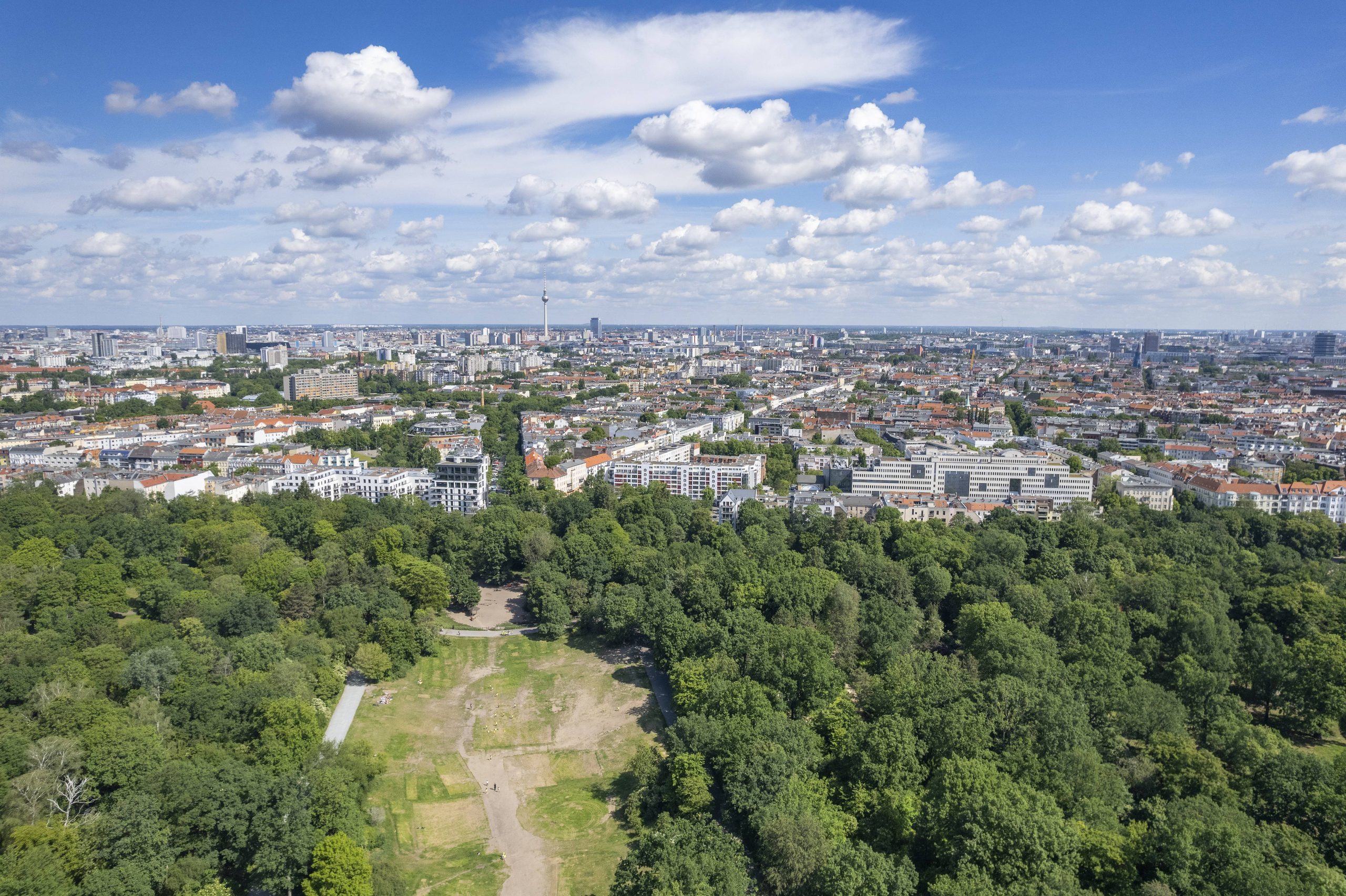
Berlin is a very green city: endless Linden-lined streets, overgrown airports, re-wilded Wall zones, expansive forest and lots of lakes. Despite its reputation as a grey area, Berlin is actually one of the greenest major cities in the world. There are over 2,500 public parks, gardens and green spaces, and any Berliner knows that the fresh air and outdoor thrills of the blossomed summer months are what makes living here worth it. To understand why, we need to look backwards. After all, trees, grass, wildflowers, landscapes – these things don’t grow overnight. It takes time, and like so many things in Berlin, it’s the city’s unique and irreplicable history that has led to what it is today. That’s also, by the way, what makes them so important to protect; once they’re gone, we can’t (and definitely shouldn’t) recreate the history that formed them. See, all of your favourite outdoor spaces – Tempelhofer Feld, Görlitzer Park, Volkspark Friedrichshain, to name a few – are one part of a complex root system of origin that made Berlin the green metropolis we run wild through every day.
Berlin’s greenness is more than just a vibe. Let’s look at the numbers. According to the Husqvarna Urban Green Space Insights (HUGSI), 49% of Berlin’s land area is green space. It compares favourably to other European metropolises known for their high quality of living, such as Oslo (48%), Vienna (44%), Amsterdam (30%) and Copenhagen (30%). The comparison looks even more favourable alongside European cities with a population exceeding three million, with Rome (47%), London (41%), Madrid (30%) and Paris (21%) all behind the German capital. Though this statistic is 10% lower than the figure quoted by the City of Berlin, who claim 59% of the city as green space, the numbers are essentially saying the same thing: Berlin’s greenness is statistically undisputed.
WHERE IT BEGAN

Berlin’s modern development began in 1648 at the end of the Thirty Years War. The city had been devastated, with a population of only around 6,000 (roughly half the pre-war population). Sixty-one years later, this figure had risen to 57,000 and by 1800, it stood at 172,000 – almost a thirtyfold increase in 152 years. Berlin’s expansion meant the capture of green spaces around its perimeter. Beyond its western boundary, Tiergarten was transformed from the fenced-off royal hunting ground of the Hohenzollern family to a public, open space around 1750. It was part of a broader movement of converting rur al hunting grounds that took place in London (Hyde Park), Paris (Bois de Boulogne) and Vienna (Prater). Tied to a transition of the relationship between royalty and a growing bourgeoisie, as philosopher Jürgen Habermas argued, the trend was a progenitor of democratic civil society.
Berlin’s greenness is statistically undisputed.
By 1914, Berlin’s population was over four million. The city had risen from a provincial outsider in the European court system – albeit one in charge of a formidable military – to a technologically advanced megacity and capital of the world’s third largest empire. The time leading up to the 20th century could be characterised as ‘organised chaos’. The state hurriedly introduced health infrastructure, such as hospitals, sewerage systems, the provision of clean water and access to nature. The Hobrecht Plan in 1862 sought to set a framework for urban expansion in Berlin. Its author, James Hobrecht, had neither the flexibility to plan the city from scratch nor the ability to convert publicly owned spaces into parks. What he did have was his idea of the Mietskaserne, the multi-storey rows of houses we know so well in Berlin, featuring rear courtyards (Hinterhöfe), a front building (Vorderhaus) and a rear building (Hinterhaus). His hope was for the Hinterhöfe to become a green utopia for neighbourhood interactions. But market forces under industrial capitalism had other ideas. The development was left to private companies, and living conditions were miserable: overcrowded, damp, stinky and dark. They were about as far from utopic as you can get.
GREEN RESPONSES TO URBANISATION

As a response to this urban squalor, three major ideas emerged in mid-19th-century Germany: the Volkspark, the Kleingarten and the protection of royal forests. According to urban environmental historian Jens Lachmund, these concepts were deeply influenced by 19th-century social reformism: the idea that nature was connected to good health and social cohesion. As Lachmund puts it, “Public health organizations emphasised the importance of ‘light and air’ and called for the restriction of the development density of inner city districts. They also advocated for the creation of parks and the planting of trees, which they supposed acted as the ‘lungs’ of the city.” Berlin’s first Volksparks were created in Friedrichshain (1848), Humboldthain (1876), Treptower Park (1888) and Viktoriapark (1894) and are early examples of the transition towards greater access to urban green spaces being central to urban planning. These plots, owned and landscaped by the City of Berlin, would provide a much-needed counterpart to the intense stresses created by overcrowded conditions.

The Kleingärten provided an alternative model. Despite the fact they are associated with high levels of regulation today, they began in the 19th century as the polar opposite: unregulated, pop-up gardens along the fringes and between the gaps of urban centres. The first Kleingärtner were a combination of guerrilla gardeners, who might grow potatoes in the rungs of an unused railway, and community gardeners, who would temporarily lease land from developers awaiting construction (which could take several years). Only after World War I were Gartenkolonien regulated by the state. Coupled with their growing importance during and after two world wars, the Kleingärten have cemented their place in Berlin’s landscape. Now they make up roughly 3% of the city’s urban space.

The 19th century also saw an important transition from royal forests existing primarily for hunting, timber, military use and water protection to becoming spaces of leisure. Grunewald in particular came under great pressure. Speculators saw it as prime real estate adjacent to the Havel, connected to downtown by train and between two centres of German imperial power: Berlin and Potsdam. The forest was saved by the intervention of civil society initiatives and forward-thinking urban planners; in 1915, they secured the acquisition of 10,000 hectares of Berlin’s forests from the Prussian state. This acquisition was managed by the Dauerwaldvertrag (Permanent Forest Agreement), which secured their indefinite protection from real estate development. From then on, the City of Berlin owned the former royal forests in Grunewald, around Müggelsee, in Tegel and in Spandau. To this day, over 17% of Berlin is covered in protected forests.
EFFECTS OF WAR
After WWI, reformist ideas dominated with centralised, top-down urban planning. Berlin pivoted from individual buildings squeezed side by side to large, suburb-sized developments covering several city blocks: Neu-Tempelhof, the Hufeisensiedlung in Britz and Afrikanisches Viertel in Wedding. These buildings were built further back from the pavement, with allocated centres for gardens and communal spaces, as well as planned green belts connecting the different sections of these suburbs.
His hope was for the Hinterhöfe to become a green utopia for neighbourhood interactions. But market forces under industrial capitalism had other ideas.
After World War II, the vast devastation also led to a full aesthetic break with the past. Both sides of the Wall wanted to re-configure urban development along more liveable lines, and this coincided with the rise of Bauhaus ideals – building higher and higher while allocating a large amount of green space in between. The city’s population had dropped to 2.8 million. West Berlin elected to reduce the density of the city centre in favour of larger developments on its fringes, such as Gropiusstadt, Märkisches Viertel and the High-Deck-Siedlung. East Berlin did both: high-density living in the heart of the city and suburb-sized developments on its fringes, such as Marzahn.
SINCE REUNIFICATION
It’s clear to see how turning points in Berlin history have impacted the city’s urban green space. The most recent example is through the reuse of areas previously incorporated into the Berlin Wall border fortifications. Though large sections of the former Wall have been privatised and sold off to the highest bidder, Nordbahnhof, Mauerpark, and the Berlin Wall Memorial on Bernauer Straße create an important green belt through Wedding, Mitte and Prenzlauer Berg, while the long sections of Eastside Gallery which have resisted privatisation provide direct access to the Spree.
Reunification was also consequential in the conversion of Tempelhof Airport back into Tempelhofer Feld. The city was left with a surplus of (three) airports, to be eventually consolidated into one: BER. In an echo of history, Tempelhof was supposed to be temporarily converted into a space of leisure in the early 2010s. Yet much like the pop-up Kleingärten, this ‘temporary’ use has become a much more permanent arrangement, albeit one that is presently under threat.
THE FUTURE

Today, to walk through Berlin’s green spaces is to walk through an archive of the city’s rise and fall, its division and its reunification, its greed and its altruism. But just because its green legacy comes from a chaotic past, that doesn’t mean the invisible hand of top-down state intervention will claim its future. Just as political organisation and civil society interventions gave rise to the Dauerwaldvertrag in 1915, so too did similar forces coalesce to protect Tempelhofer Feld during the referendum of 2014. Those same forces (e.g. 100% Tempelhofer Feld) are currently trying to save it now too.
Across the road, Hasenheide is showcasing a hopeful approach to green urban planning. Particularly due to the initiative of Die Grünen in Neukölln, €5.5 million have been invested to future-proof the Volkspark against the expected long-term effects of climate change. This didn’t just happen; it came from a process of organising, lobbying, planning and convincing local lawmakers to take urban green spaces seriously. As stated on berlin.de, “The outstanding potential of the Hasenheide for the urban climate, biodiversity and human health were recognised.” It continues, “Its natural contribution to the urban climate, the health and recreation of the population and biodiversity were to be stabilised and further developed.” It shows that, even with the existence of market pressures and against the instincts of state politicians, grassroots political organisations do still shape the future of Berlin’s urban environment.