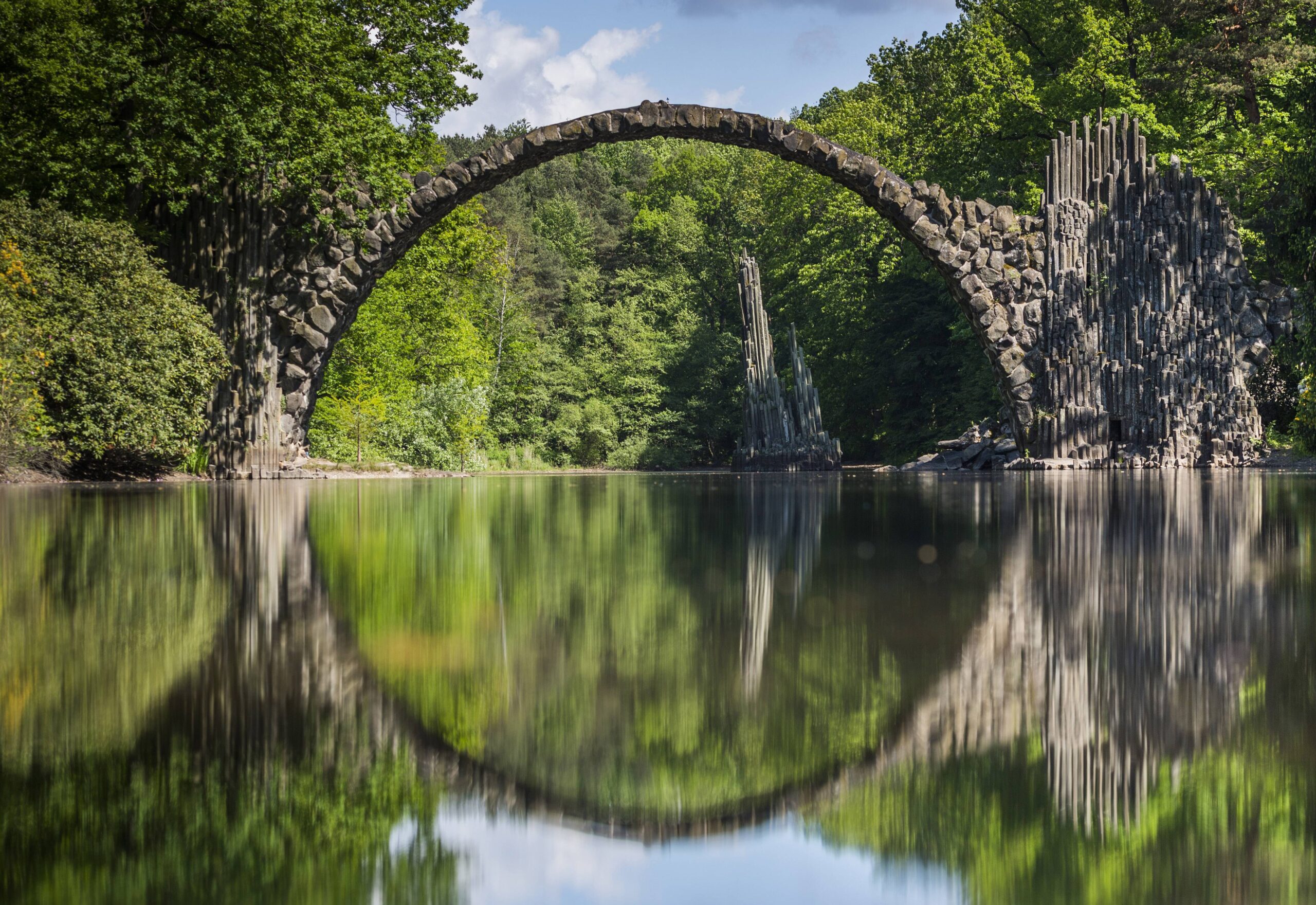
The magical 19th-century ‘Devil’s Bridge’, Rakotzbrücke, has such a perfectly designed arch that it creates a symmetrical, floating full circle in its reflection in the water below. Folklore claims that to have achieved such a spectacular optical illusion, a deal must have been made with the devil. The cultural phenomenon of devil’s bridges has existed since the Middle Ages. These ancient, precarious, arched stone crossings can be found across Europe, all sharing the same diabolical folklore: that such an architectural wonder could only have been achieved using supernatural assistance. Of the roughly 100 devil’s bridges scattered across the continent, none is more iconic than the Rakotzbrücke.
Breathtaking and picture-perfect, Rakotzbrücke is like something out of a fairy tale. Drawing visitors from across the country, the iconic sight is, for many, a highly intentional bucket list item. Over 150 years old and steeped in mysticism, the delicately thin basalt bridge appears like a supernatural portal above the water. It’s not unlike some lost artefact from The Lord of the Rings. It’s no surprise, then, that it has been used as the backdrop for several movies, including the latest instalment in the Matrix series. Having gained notoriety through social media, it’s one of the most photographed monuments in the country, thanks to its perfect curvature. Depending on the time of day and season, the bridge’s striking reflection shifts in colour and consistency, making for photography opportunities that change with the seasons.
The Highlight of Rhododendron Park

The bridge is the primary attraction in the Rhododendron Park, situated in the tiny village of Kromlau in Northern Saxony, just south of the border with Brandenburg. The 200-acre park is a pristine, elaborately designed English-landscape garden with winding paths, water features and ornate statues, interspersed with several manor houses. Once a year, the park throws a big festival, the Blütenfest, to celebrate the blossoming of the rhododendrons and azaleas, as the bushes flaunt their exuberant purple and white colours.
These precarious, arched stone crossings can be found across Europe, all sharing the same diabolical folklore.
Commissioned in 1860 by landowner Friedrich Hermann Rötschke, the bridge itself cannot be crossed. Designed with mathematical precision, it is entirely decorative: a theatrical structure integrated into a landscape solely for aesthetics. After buying the estate back in 1840, Rötschke wanted to fashion the land into something worthy of nobility, with Romantic-era gardens and ornaments carved from stone imported from the Sächsische Schweiz. The Rakotzbrücke, named after the Rakotzsee that flows beneath it, took 10 years to build and took the life of a local sculptor (perhaps the devil got his deal after all).
The Rhododendron Park Kromlau happens to be situated between two UNESCO World Heritage Sites. Just five kilometres away on the Polish border lies Muskauer Park, established by the renowned Prince Hermann von Pückler-Muskau and home to some of Central Europe’s most famous English gardens. It was here that the original owners of Kromlau Park found the inspiration for their own estate. To the immediate south of the park is the Muskau Arch, a vast UNESCO World Heritage Site and Global Geopark: a landscape that has been reshaped after years of opencast mining, leaving giant physical scars through the vast woodland. Those who decide to walk to the Rhododendron Park from the train station at Weißwasser (over an hour and a half away) will pass through the woodlands and be able to see firsthand a part of the Lausitzer Seenland (Lusatian Lake District). This series of lakes is where the local government has, as part of a regeneration scheme, artificially filled the once-empty mines with natural water.
Muskau Forest Railway

Walking to the Rakotzbrücke is just one of many ways to reach it. Sitting in a remote corner of Saxony, the bridge is just over two hours from Berlin. It’s best reached by car, making for a great stopping-off point when travelling between Dresden, Bad Muskau, the Sächsische Schweiz and Görlitz. One of the best ways to get around the area, however, is with the narrow-gauge heritage Waldeisenbahn Muskau (Muskau Forest Railway). Founded in 1895 to haul brown coal from the local forests to nearby factories, the historic diesel and sometimes steam railway is now a tourist attraction that shuffles visitors around the area, from Weißwasser to Kromlau and all the way to Bad Muskau.
It’s also thanks to its remoteness that the Rakotzbrücke doesn’t easily succumb to masses of tourists or long lines. At the same time, the park has little to offer in the way of restaurants or refreshments, so day-trippers need to come prepared for the long day ahead. Completely free to visit and open year-round, the Rhododendron Park allows visitors to step straight into nature, immerse themselves in the gardens and marvel at the bridge’s surreal, gravity-defying design, regardless of the time of year. Following a massive, multi-million-euro renovation in 2021, the heritage-listed monument looks more glorious than ever, standing as a timeless testament.
At a Glance

Getting There:
Kromlau is a two-hour drive from Berlin. Alternatively, take regional trains to Weißwasser, then either walk or take the local bus.
Where to Stay:
There are a handful of boarding houses and guest houses in the nearby villages, or check out Neptuncamp Halbendorfer See if you want to camp beside a beautiful lake.
Where to Eat:
Vida’s Konditorei & Café is a surprising little pastry shop in the middle of nowhere. Their Pflaumenkuchen, made with locally sourced plums, should not be passed up. Alternatively, jump across the Polish border and grab a freshly poured Żywiec beer in Łęknica.