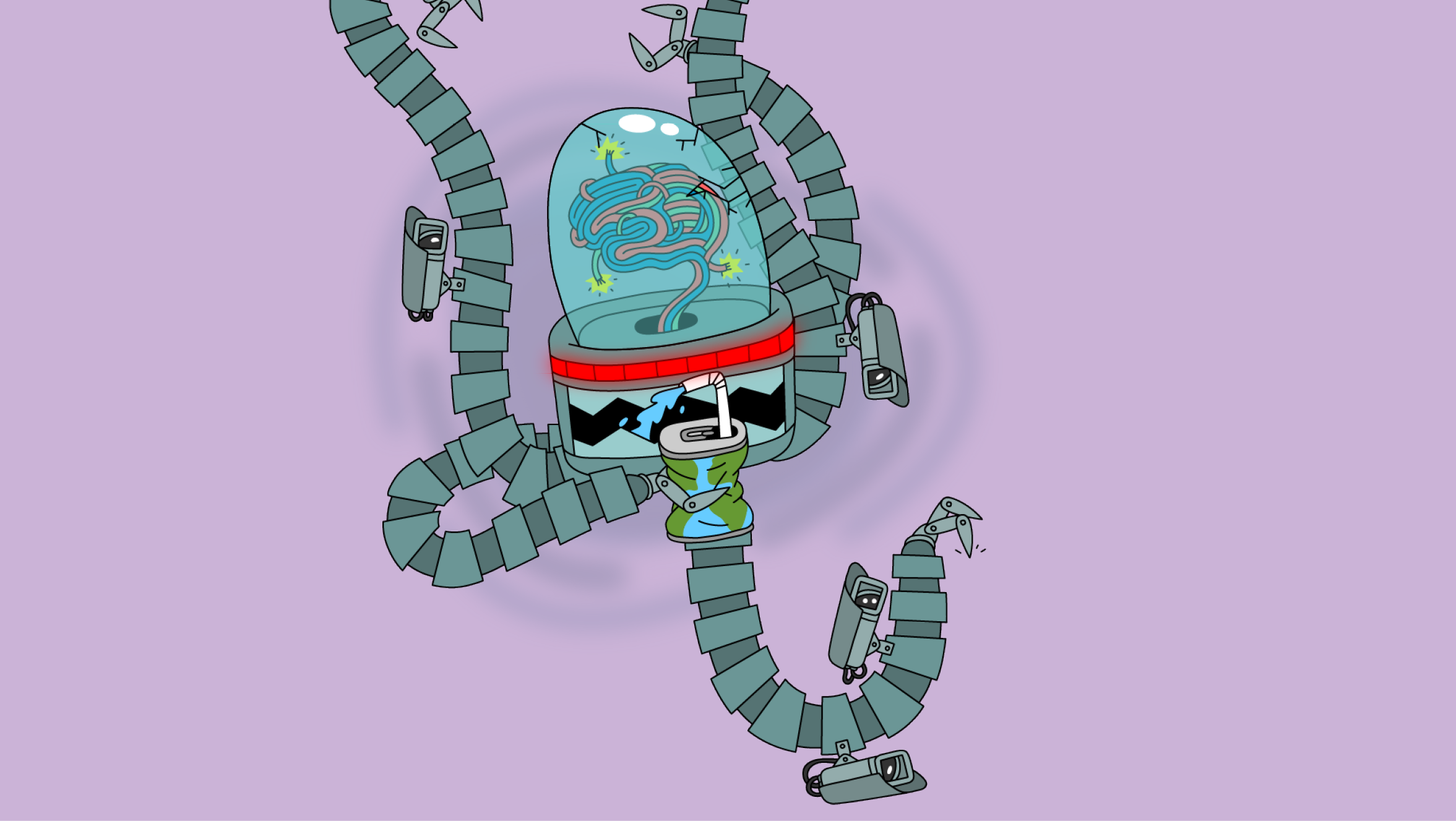
We don’t need to tell you that Kottbusser Tor is home to a vibrant and chaotic array of characters. People spill out of the station and argue on the pavement. A group of teenagers mess around. Red-light-denying cyclists squeeze between pedestrians. Friends hug. Couples kiss. People wait, smoke, eat, shout. It makes you wonder, what would a machine think of this scene? This August, Berlin police installed around 30 new cameras on Kottbusser Tor. These aren’t your classic CCTV cameras whose purpose is to record what happens and store the information. These fancy new cameras are connected to artificial intelligence software. They’re designed to analyse movement in a live video stream and identify behaviour that’s ‘suspicious’ or might indicate danger. If the system detects something along these lines, an alarm can be sent to police officers; it’s up to them to decide what to do next.
This is just one of the ways AI will infiltrate your private life in Berlin – but it’s a big one. Sure, our phones have been listening to us for years and we gave our fingerprints freely to Apple, but AI kicks the dystopia up a notch. Berlin authorities claim that the system is not designed to recognise faces. Instead, the software is intended to identify patterns of behaviour associated with potentially dangerous situations. Yet it doesn’t get much more Minority Report than being deemed a criminal before you’ve done anything wrong. Kottbusser Tor is the first location outside the public transport system where the city is deploying this kind of AI-assisted surveillance. Other locations, including Warschauer Brücke, Görlitzer Park and Alexanderplatz are expected to follow in its digital footsteps.

The police have long been designated Kotti a kriminalitätsbelasteter Ort, or a crime-heavy location. Interior Senator Iris Spranger (SPD) has described it as “the crime hotspot with by far the highest number of cases” in relation to its size. There is a genuine reason for concern about safety here. Many people who live and work around Kotti want less crime and a public space where they feel comfortable. “We want to test what additional contributions modern AI technologies can make to recognising dangerous situations at an early stage,” Spranger has said. An algorithm can monitor dozens of camera feeds at a rate that a human simply cannot. If somebody starts hitting another person, the system can purportedly recognise the movement and flag it. A police officer can then look at the footage and decide whether an intervention is necessary.
Sounds useful, right? Of course, it’s not so straightforward. “Social interactions are constantly taking place in a busy subway station,” Michael Kolain tells us. Kolain is the head of policy at Berlin’s Center for Digital Rights and Democracy. “I doubt the system can reliably distinguish between: is this a playful scuffle among friends or a serious fight or violent attack? Is someone handing over a pretzel or drugs? Is a person resting on a bench, waiting for someone or loitering there in a way that poses a risk?” Finn, a local we spoke to at Kottbusser Tor, was less concerned with the technical details than with the feeling of suddenly having another invisible system watching him. “It feels intrusive. To know that my behaviour and actions are constantly being monitored and assessed by a robot. It makes me feel anxious and paranoid.”

Clara Bünger, member of the Bundestag for Die Linke, has been an outspoken critic of these systems. “The claim that this technology will help authorities respond more quickly to dangerous situations is, for now, just that – a claim. I’m not aware of any evidence to support it. When we talk about responding to dangers and improving safety, we also have to ask: whose safety are we talking about?” Bünger points towards demands from residents and local initiatives in Kreuzberg for greater investment in addiction services, outreach social work and other community projects. “Apparently, there’s no money for that. At the same time, millions are being spent on surveillance.” Die Linke’s Friedrichshain-Kreuzberg branch has put the projected investment at around €2.5 million, with a further €2.1 million in operating costs through 2030.

But does this technology actually make people feel safer? Hamburg has been experimenting with intelligent video surveillance since 2023, initially at Hansaplatz and later at Hachmannplatz, near the main railway station. Police there say the technology has already helped identify incidents. During the original Hansaplatz trial, an AI alert drew officers’ attention to a serious assault that had apparently gone unnoticed by passers-by, including a suspected kick to the victim’s head. A camera spotting a serious crime that humans missed is one of the stronger arguments for the technology, but for many, the pay off isn’t worth it. For Kolain, technology cannot substitute for people. “There’s a concern that the use of technology will lead security forces to spend more time behind screens, or even be reduced in numbers, rather than actually being in the field. People feel safer when there are people on the ground checking to make sure everything is in order. They can also easily deescalate situations and intervene on time. If these systems are used to reduce drug-related crime and violence, it’s also likely that crime hotspots will simply shift a few subway stations away.”
Bünger sees the expansion as part of a much wider shift. “After Mannheim and Hamburg, Berlin is already the third city to introduce AI-assisted surveillance,” she told The Berliner. “The federal police are also set to be given these powers, and preparations are underway in other federal states as well. The expansion is continuing, while there has so far been little public resistance.” The federal government is indeed pursuing expanded biometric surveillance powers for federal security agencies. Bünger herself has criticised plans to give the Bundeskriminalamt, Federal Police and Bundesamt für Migration und Flüchtlinge greater powers to use AI-supported biometric surveillance, arguing that the measures could pave the way towards uncontrolled mass surveillance.
Is this a playful scuffle among friends or a serious fight or violent attack? Is someone handing over a pretzel or drugs?
“First, surveillance is normalised, and then it’s expanded later on,” Kolain says. “The more widespread government video surveillance becomes, the easier it is to create movement profiles of individual people. And as I said, it’s then only a small step from AI-based risk detection to biometric facial recognition.” Bünger is even more blunt about where she believes Germany is heading. “For several years now, we have been witnessing a reactionary transformation of the state,” she insists, pointing to restrictions on civil liberties and what she describes as an expansion of state surveillance powers. “State control is being expanded while transparency and the mechanisms for holding the government accountable are being curtailed. I find this development deeply alarming.”
There’s a tendency in debates about surveillance to retreat to the same familiar argument: if you’re not doing anything wrong, why should you care? Digital rights campaigners such as Kolain reject this. “People who come to Berlin and live here appreciate the sense of freedom. You can move through the city unnoticed, looking however you want.” What’s legal today, may be illegal tomorrow. In Berlin, more than any other city, we should understand that the legal system is not always on the right side of history.
It’s far from the first time Berliners have had their privacy violated. Berlin today is still scarred by the legacy of the Nazis and, in more recent times, the Stasi, whose secret police have gone down in infamy for their tactics of intrusion into the personal lives of private citizens. It’s hard not to wonder what such an authoritarian regime would be capable of with AI technology in their hands.