Contemporary artist Gregor Hildebrandt is obsessed with music and with using its physical remains as material. Born in Bad Homburg, he has lived and worked in Berlin since 1998, collaborating closely with bands and musicians and turning the physical residue of their recordings into artworks. For his signature ‘negative’ paintings, magnetic tape is pressed onto canvas, peeled away and then reapplied. A graduate of Mainz and UdK Berlin, Hildebrandt has been a professor of painting and graphics at the Munich Academy since 2015. Song and film references run throughout his work, their traces physically imprinted into its surfaces.
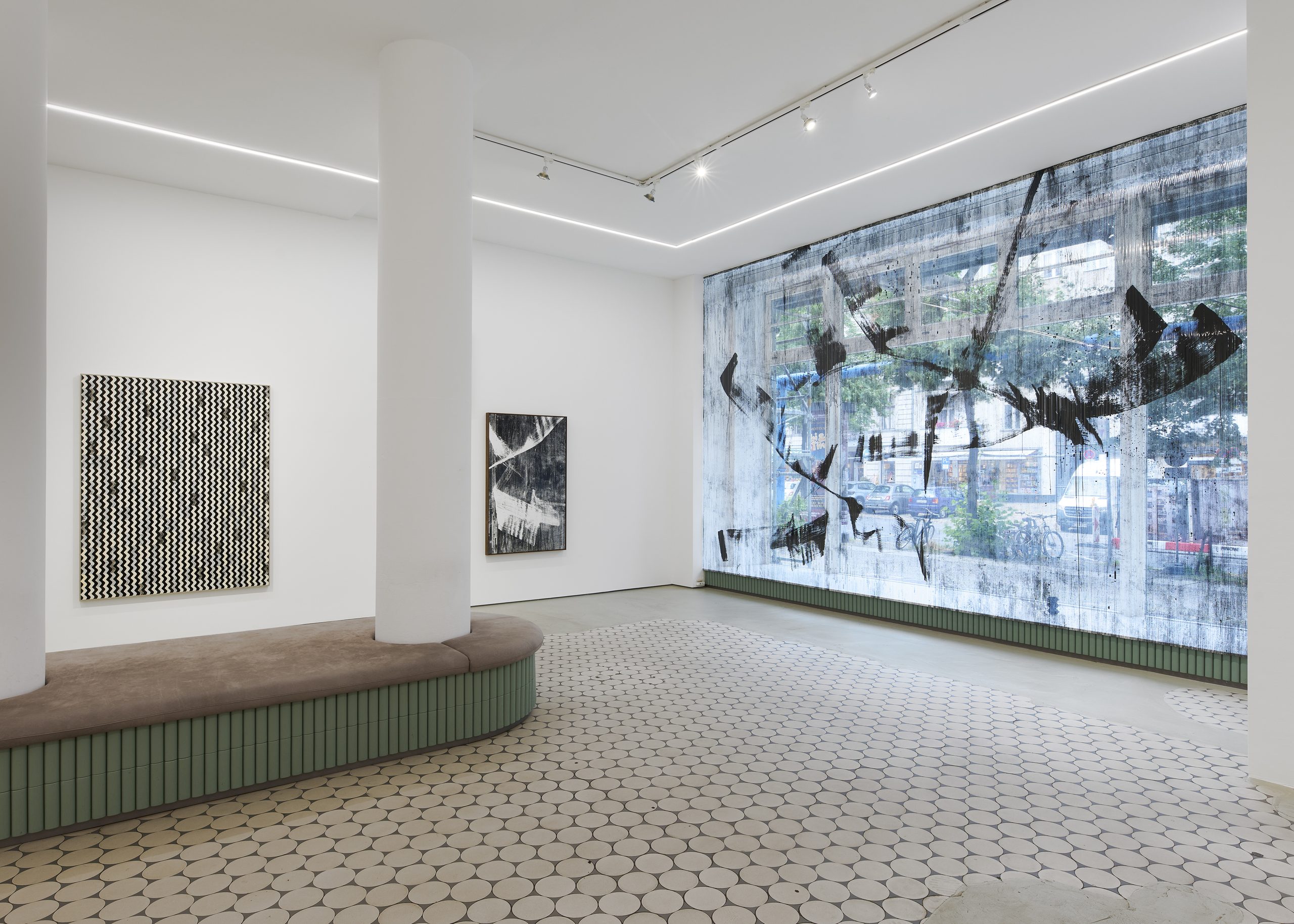
In your new exhibition, a large curtain made from the magnetic tape of Martin Šulík’s film The Garden (1995) hangs across the gallery window. What’s the idea behind it?
From outside, the tape reflects the street back at you. Inside, you encounter its reverse. I removed seven sections from the curtain and used them to make reverse paintings, so those seven missing fragments become the internal exhibition. It’s almost a yin-and-yang structure – positive and negative, inside and outside.
Why seven?
The number seven comes from the fairy tale The Brave Little Tailor, you know: “seven at one blow”. He kills seven flies with one stroke, puts it on his belt as this heroic statement and everybody assumes he’s done something extraordinary.
The Garden is a strange Slovak film about a man retreating to his grandfather’s overgrown garden. Why use it?
I think it’s a very enchanting film. How do you say ‘verwunschen’? When you watch the film, it’s a bit like a dream you don’t quite remember the next day.
I started watching it. It’s enjoyable but slow. I found it difficult to stick with it…
Exactly. You’re left with a feeling, an atmosphere, without necessarily remembering what happened. It’s similar with my paintings. You don’t necessarily see the connection to a song I’m referring to when you look at them. That’s also why I chose the film – this idea of things appearing in opposite ways. Outside, you see the exhibition through the tape of The Garden, and then inside you experience it completely differently.


The text around the exhibition talks quite a lot about garden work, cultivation, growing and making…
I think that’s more the writer’s association! But actually, I don’t like gardening very much. I prefer walking through grass or lying underneath a tree. For me, the garden is more of a spiritual idea than about pulling out plants or working the soil.
Do you have a garden?
Yes, in the countryside. It’s all quite new and it’s a lot of work. My partner really enjoys it. She’s always working. Usually, she’s doing a few things at once, weeding while on the phone; it helps her relax. I help, of course. But after spending a week teaching in Munich, I’m also very happy to come back to the city, go to the market and buy my vegetables.
Where does the title of the exhibition Park by POCO come from?
Park can mean parking your car, but it can also mean a garden, like the Jardin du Luxembourg. I like the dual meaning. But I also like that when somebody visits me at the studio, I can just tell them, “Park by POCO.”
By POCO, you mean the horrible home furnishing store, right?
I thought I should look outside painting and make paintings like Sonic Youth or The Cure.
I’ve never actually been inside, but I like the car park very much. It’s my shortcut when I walk from the studio to the U-Bahn. I cross the car park and come out towards Osloer Straße. And suddenly, it doesn’t feel like Berlin anymore. It almost feels like Tel Aviv because it’s so incredibly busy. There’s a Turkish supermarket, an Afro shop, Asian markets – all these different nationalities together. It’s very cosmopolitan and crazy. You have to come.
What made you begin working with cassette tape and vinyl?
When I was studying, everybody was painting like Cy Twombly. It was incredibly fashionable. Everyone was listening to Stravinsky’s The Rite of Spring and making abstract paintings. It became a theme throughout the whole class; everybody wanted to paint like their idol, and inevitably the paintings started to resemble that idol. I wanted to make paintings that didn’t look like somebody else’s work. So I thought I should look outside painting and make paintings like Sonic Youth or The Cure. That led to my collages. They’re full of music, but they aren’t connected to paintings that already exist. It was a way of finding my own language.
You bring gestural marks into what is otherwise a very strict conceptual process. How did that come about?
It was actually a mistake. An assistant glued the tape the wrong way around in the studio. When I went to peel it off, we suddenly saw this raw, residual structure beneath it. Up until then, everything was flat and monochrome and I realised I could capture the physical gesture of the brushstroke within this rigid system. It opened up a completely new direction for me. Now, in these new works, you can see the hairs of the brush in the stroke.
Cassette tapes are largely obsolete, and vinyl was for a time too. Is keeping that technology alive important to you?
It’s less about the technology and more about the associations it holds. I love music, and it’s a huge part of all our lives. Certain sounds immediately bring you back to a particular moment or association. But music itself is invisible. You can hear a song, but you can’t see it or touch it. It isn’t material. A song is something you can’t quite catch. Maybe that’s also why I repeat it.

There seems to be something almost destructive in the process – pulling apart cassettes and records to make something else.
No, I think it’s the opposite. I’m saving them in a way. These things would otherwise be thrown away. We buy them cheaply at flea markets or rescue them from the garbage. It’s not about destroying something but transforming it. And the music itself isn’t lost – the songs still exist digitally.
But after you’ve used it, you can’t put the cassette back into a machine and listen to it.
Yes, but a lot of the vinyl we use didn’t exist before; we pressed it ourselves. I have my own label, Gregorski Records, producing music mostly with former students of mine. I only publish artists.
When you’re making a tape painting, using a song, say, by The Cure, are you actually listening to that very song as you make the work?
Yes, that’s really important. Then the song’s inside the work, transformed. You can’t listen to it, but you can touch it.
You host a lot of bands and events in your studio. Is music always playing?
A song is something you can’t quite catch. Maybe that’s also why I repeat it.
When we started working with assistants, they were often frustrated because I would listen to the same song over and over again. Now everybody has AirPods and listens to their own things. There’s maybe less conversation but also a kind of freedom. Some listen to podcasts, but I don’t because I can’t concentrate on something else at the same time. Podcasts are only good for driving.
There’s an intriguing new work in the show, ‘über Weiden weht der Wind’, that took me a while to understand what I was actually looking at.
Yes, it’s based on the tiny felt piece inside a cassette that pushes the tape against the playback head. I was fascinated by the idea of the song constantly sliding across this little surface. What you see in the painting is the dust and residue that accumulated there as the tape passed over it. So you’re looking at the physical deposit of time passing. And it isn’t only songs and bands. There are operas, fairy tales, all kinds of recordings. I once made a similar work from 26,000 cassettes. I won’t be doing that again.
These works are incredibly labour intensive. Does that labour matter to the meaning of the work?
All the works are arbeitsintensiv. But the labour itself isn’t important; there’s something meditative about it. Maybe for me it’s easier to paint with music than it is to paint with oil colours. People often ask me about using cassettes and vinyl and all this supposedly old-fashioned material, as though I’m some kind of nostalgic artist. But I always say no; cassettes and vinyl are much more modern than oil paint.

You’ve built a bar in the exhibition as well.
The bar isn’t actually part of the exhibition. It’s more a side project with the gallery.
But the aim is to get people to hang out there a bit?
It’s almost like a bonus track to an exhibition. I like the idea of having somewhere people can stay and enjoy it. We’ve covered the bar with vinyl records, so you don’t really see what’s behind it. The fridges are filled with cold beer and everything. And there’s a jukebox, too, made out of vinyl – so it doesn’t work.
Park By POCO is on until Oct 9 at Wentrup Gallery, details